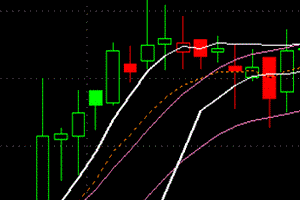
Moderate Balanced is trading at 12.12 as of the 24th of January 2026; that is 0.33 percent increase since the beginning of the trading day. The fund's open price was 12.08. Moderate Balanced has less than a 18 % chance of experiencing some financial distress in the next two years of operation and had a fair performance during the last 90 days. The performance scores are derived for the period starting the 26th of October 2025 and ending today, the 24th of January 2026. Click here to learn more.
The Portfolios main investment strategy is to invest in other Saratoga Advantage Trust mutual funds andor unaffiliated registered investment companies and exchange-traded funds . It will invest in equity, fixed income and alternative instruments through its investments in the underlying funds.. More on Moderate Balanced Allocation
Moderate Balanced Allocation [SBMCX] is traded in USA and was established 24th of January 2026. Moderate Balanced is listed under Saratoga category by Fama And French industry classification. The fund is listed under Allocation--50% to 70% Equity category and is part of Saratoga family. The entity is thematically classified as Moderate Funds. This fund at this time has accumulated 1.18 M in assets with no minimum investment requirementsModerate Balanced is currently producing year-to-date (YTD) return of 1.94% with the current yeild of 0.02%, while the total return for the last 3 years was 10.94%.
Check Moderate Balanced Probability Of Bankruptcy
Instrument Allocation
Sector Allocation
Investors will always prefer to have their portfolios divercified against different sectors. The broad sector allocation increases the possibility of making a profit or at least avoiding a loss. However, this may also reduce the expected return on Moderate Mutual Fund. Generally, it depends on diversification level and type but usually, the broader the sector allocation, the less risk can be expected from holding Moderate Mutual Fund, and the less return is expected.
Institutional investors that are interested in enforcing a sector tilt in their portfolio can use exchange-traded funds, such as Moderate Balanced Allocation Mutual Fund, as a low-cost alternative to building a custom portfolio. So, using sector ETFs to diversify your portfolio can be a profitable strategy. However, no matter what sectors are desirable at a given time, no single industry should ever make up more than 20 percent of your stock portfolio.
Top Moderate Balanced Allocation Mutual Fund Constituents
The fund maintains about 16.07% of assets in cash. Large To find out more about Moderate Balanced Allocation contact the company at 800-807-3863.
Moderate Balanced Investment Alerts
The fund maintains about 16.07% of its assets in cash
Moderate Balanced Thematic Classifications
In addition to having Moderate Balanced mutual fund in your portfolios, you can add positions using our predefined set of ideas and optimize them against your very unique investing style. A single investing idea is a collection of funds, stocks, ETFs, or cryptocurrencies that are programmatically selected from a pull of investment themes. After you determine your favorite investment opportunity, you can then obtain an optimal portfolio that will maximize potential returns on the chosen idea or minimize its exposure to market volatility. If you are a result-oriented investor, you can benefit from optimizing one of our existing themes to build an efficient portfolio against your specific investing outlook.
Moderate FundsFunds with moderate expected return and risk
Moderate Balanced issues bonds to finance its operations. Corporate bonds make up one of the largest components of the U.S. bond market, which is considered the world's largest securities market. Moderate Balanced uses the proceeds from bond sales for a wide variety of purposes, including financing ongoing mergers and acquisitions, buying new equipment, investing in research and development, buying back their own stock, paying dividends to shareholders, and even refinancing existing debt. Most Moderate bonds can be classified according to their maturity, which is the date when Moderate Balanced Allocation has to pay back the principal to investors. Maturities can be short-term, medium-term, or long-term (more than ten years). Longer-term bonds usually offer higher interest rates but may entail additional risks.
Moderate Balanced intraday indicators are useful technical analysis tools used by many experienced traders. Just like the conventional technical analysis, daily indicators help intraday investors to analyze the price movement with the timing of Moderate Balanced mutual fund daily movement. By combining multiple daily indicators into a single trading strategy, you can limit your risk while still earning strong returns on your managed positions.
Moderate Balanced's time-series forecasting models are one of many Moderate Balanced's mutual fund analysis techniques aimed at predicting future share value based on previously observed values. Time-series forecasting models ae widely used for non-stationary data. Non-stationary data are called the data whose statistical properties e.g. the mean and standard deviation are not constant over time but instead, these metrics vary over time. These non-stationary Moderate Balanced's historical data is usually called time-series. Some empirical experimentation suggests that the statistical forecasting models outperform the models based exclusively on fundamental analysis to predict the direction of the market movement and maximize returns from investment trading.
Other Information on Investing in Moderate Mutual Fund
Moderate Balanced financial ratios help investors to determine whether Moderate Mutual Fund is cheap or expensive when compared to a particular measure, such as profits or enterprise value. In other words, they help investors to determine the cost of investment in Moderate with respect to the benefits of owning Moderate Balanced security.
Determine any equity ratings based on digital recommendations. Macroaxis instant equity ratings are based on combination of fundamental analysis and risk-adjusted market performance